

Lots of examples show that human over-exploitation of the natural world, as a significant amount of debt owed to nature, will always suffer because they cannot repay the revenge of nature in the whole human history. Industrial society will do more damage to the environment with a larger scale and higher speed consuming natural resources than agricultural community.
According to the book named "Limits to Growth" written by DH Meadows, coal, oil, metals and other non-renewable resources will exhauste 2100 ago. Even though this estimate has some exaggerated factors, we could not pass up these resources for centuries in any case. In another side, renewable resource, such as fertile land, forests, flora and fauna, air and water, has suffered a permanent damage result from the development of industrial world. The global wildlife has been facing a major crisis.
Perspective on the current level of industrial development: In the past 10 years, papers from biotechnology and medicine are 49% of the natural sciences all over world; recently, about 40% to 50% of annual Top Ten scientific and technological achievements are in life scientific fields at home and abroad. biotechnology industry based on biotechnology and life sciences makes more progress, and has introduced new products and new patents. Biotechnology industry has become an international technological competition as well as the focus of economic competition, and it will also become a powerful weapon to help humans live in harmony with nature.
June 1972, "The First Human Environment Conference" was held in Stockholm, Sweden sponsored by the United Nations. It make progress for international environmental. "Declaration on the Human Environment" than was passed in this meeting is the first global international documents in human history to protect the environment, and it marks the birth of the international environmental law.
The International Environmental Education Conference, which published the famous "Belgrade Charter," was held in Belgrade in 1975. This Charter sets out the purpose, goals, objects and guiding principles of environmental education.
Copenhagen World Climate Conference was held in Copenhagen the capita of Danish in2009, and it absorbed many representatives from 192 countries, who are to discuss the follow-up program after the first stage of "Kyoto Protocol" expired. The conference is regarded as "the last chance to save humanity". After that, "United Nations Framework Convention on Climate Change" published.
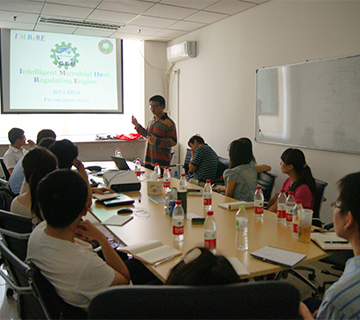
Nowadays,energy crisis and global warming have become increasingly prominent and threated the healthy development of human society. To solve these issues to some extent, we,members from BIT-CHINA,investigate the basis of Bioproduction process at home and abroad and hope to create one kind of heat self-regulated E.coli with the help of synthetic biology.
We can see that E. coli is still the main industrial model strain used in the process of domestic production of bio-based chemicals from the current industrial production process. Applying our new E.coli to the fermentation industry is important to biological industry restructuring and healthy development. Our research can broaden the optimum fermentation temperature of E.coli to effectively activate reaction process, accelerate the metabolic process flow and control the reaction mass transfer efficiency, and thereby improving the efficiency of cell product synthesis; In addition, the application of this project can effectively save water and power resources, reduce fuel consumption, such as coal and oil, and thus greatly reduce the amount of CO2 generated by thermal power, effectively curb global warming and other environmental issues.Last but not least, our project is conducive to the sustainable development in our society, the harmony in natural ecosystems, and the environmental protection of global village,