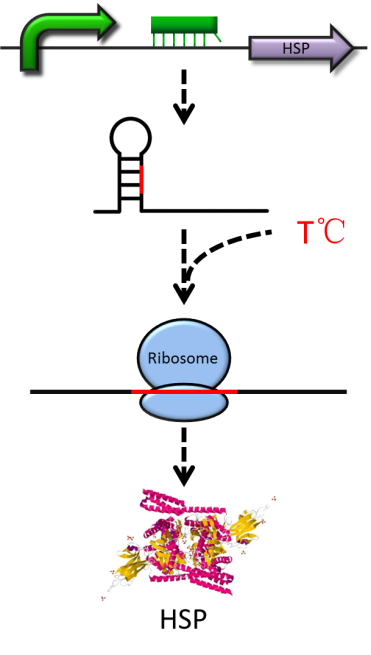
Bacteria use complex strategies to control gene expression in response to environment temperature changing. Many genes encoding heat shock proteins and virulence factors are regulated by temperature sensing RNA sequences, known as RNA thermometers (RNATs), which are located in the 5’untranslated region of the mRNA folding into secondary structure that shed RBS to influence translational efficiency in low temperature. But when temperature is increased to a certain temperature, the RNATS release RBS and the blocked genes express.
Most of gene expression responding to temperature shock measure not the temperature itself but the consequences of temperature-induced damage. Those reaction are effected by temperature indirectly. However, RNA thermometers response to temperature immediately, precisely, and controllably. So using RNA thermometers to control our heat shock proteins expression is a good choice. The RNA thermometers can be available included two types, the natural RNATS and the synthetic RNATS.
Natural RNATS
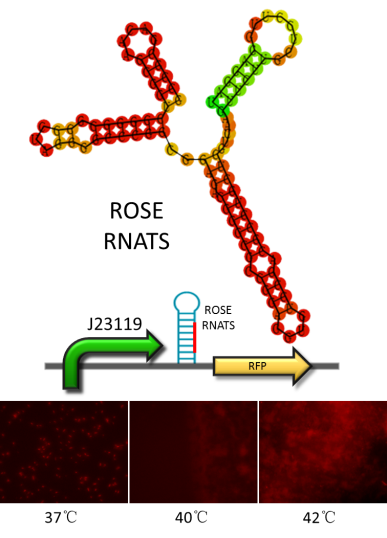
ROSE family
ROSE RNATS were found in numerous alphaproteobacteria and gammaproteobacteria. All known ROSE elements control the expression of small heat shock genes. ROSE-type structures are composed of two, three or four individual hairpins. The 5ʹ-most hairpins remain stable under heat shock conditions, but the 3ʹ-most hairpin that pairs with the SD sequence is only stable at low temperatures. Temperature-induced local melting in this hairpin exposes the SD sequence, facilitating ribosome binding. The SD region is occluded at 30 °C, partial melting occurs at 37 °C, whereas an increase to 42 °C facilitates the mRNA–ribosome interaction owing to full liberation of the SD and AUG start codon. This type feeds our needs. It may not initiate translation at a certain temperature completely, but the level of expression increase alone with the temperature increasing.
Four U family
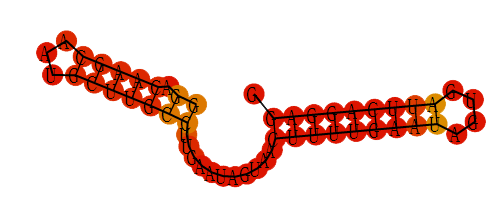
Another family of RNATs is a stretch of four uridines that pairs with AGGA in the SD sequence. FourU elements exist in the 5ʹ UTRs of several heat shock and virulence genes. It has two distinct hairpins. The first hairpin is heat stable, however the second hairpin is temperature sensitive, which hide the SD region through the fourU. The formation of the ternary translation initiation complex occurs at high (45 °C) but not at low (30 °C) temperatures.
Synthetic RNA thermometers
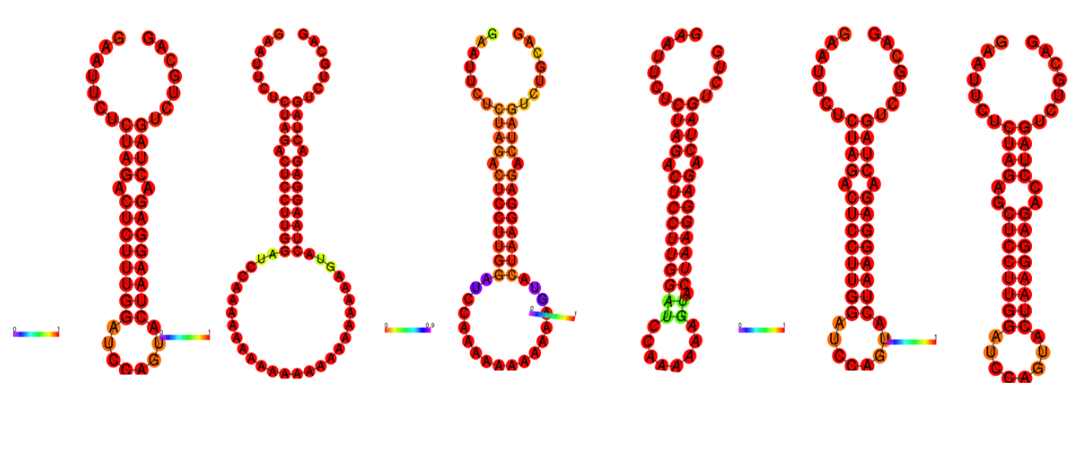
Obvious, RNA thermometers provide us superb genetic tools to induce or repress gene expression. However, most natural RNA thermometers are relatively large. They fold into rather complex secondary structures and have been suggested to undergo gradual conformational changes in response to changes in temperature. Therefore, we want to construct smaller and more convenient synthetic RNA thermometers to achieve the goal of hierarchy Heat-resistant regulation. Under the following principle we construct a series of synthetic RNA thermometers.
Stem stability can be influenced by (i) changes in the size and/or GC content of a perfectly matched stem and (ii) introduction of mismatches at different positions.








 (From: http://pdslab.biochem.iisc.ernet.in/hspir/chaperone.php)